
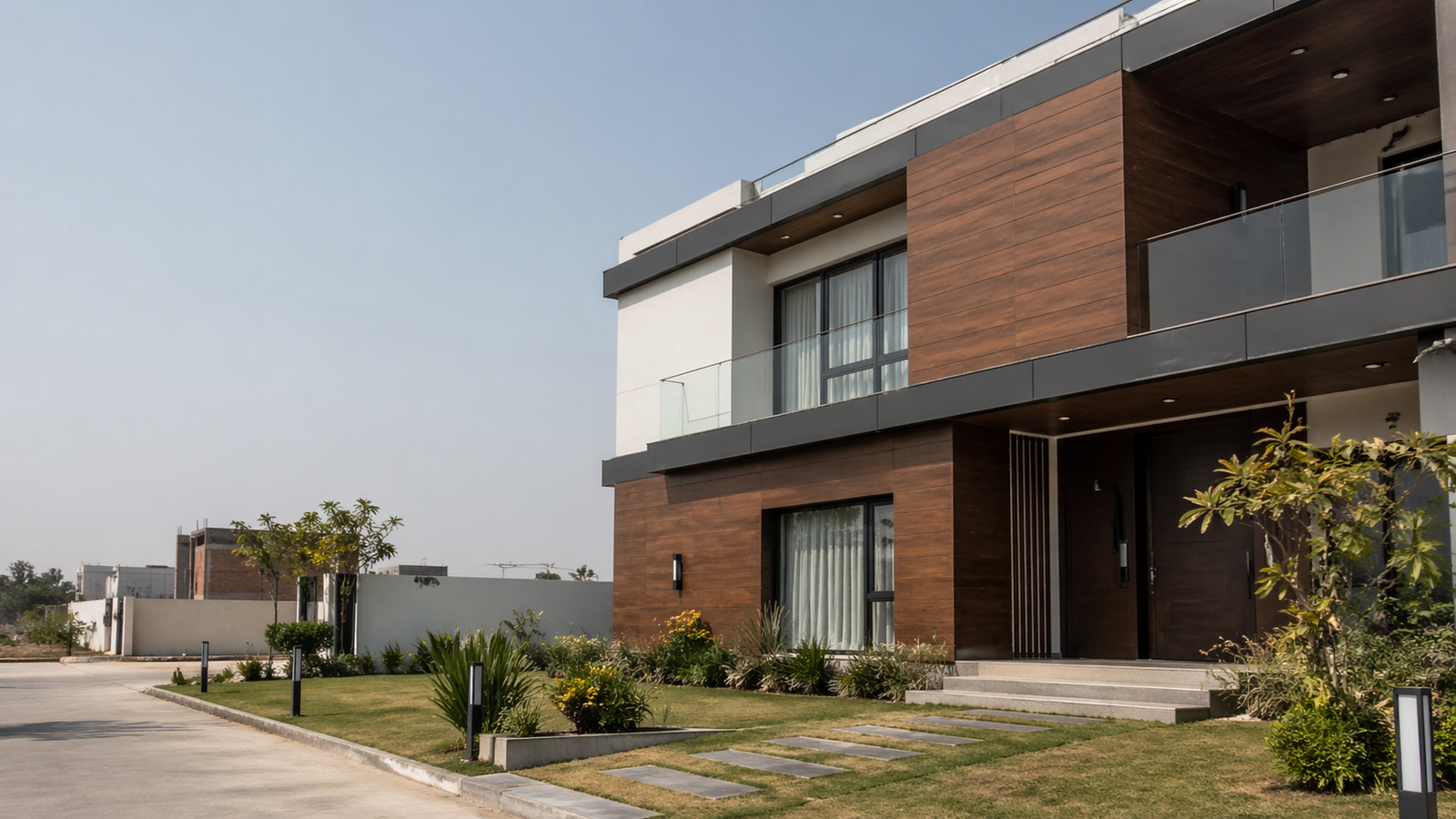
HPL and WPC are two materials that often come up together when people plan cladding, doors or panels, and they are easy to confuse. They look similar in a brochure but behave quite differently in real use. Understanding the distinction will help you pick the right one for your project instead of guessing. Here is a clear, no-jargon comparison.
What is HPL?
HPL, or High Pressure Laminate, is a dense panel made from layers of kraft paper and resin pressed together under high heat and pressure. The decorative pattern and a protective overlay sit on top. The result is a hard, smooth, durable surface that is excellent for facades, gates, partitions and furniture.
What is WPC?
WPC stands for Wood Plastic Composite. It is made by combining wood fibres or flour with plastic polymers and additives, then moulding the mixture into boards or profiles. WPC is often used for doors, door frames, outdoor decking and certain panelling applications. It aims to offer some of the look of wood with better moisture resistance.
Surface and finish
This is one of the clearest differences. HPL has a refined, factory-finished surface with sharp, consistent decorative patterns, whether that is wood grain, stone or solid colour. WPC’s surface is generally more utilitarian; it can be laminated or painted, but on its own it does not match the crisp decorative finish of HPL. If surface appearance and design variety matter, HPL leads.
Strength and density
HPL is extremely dense and hard, which makes it highly scratch and impact resistant on the surface. WPC is lighter and somewhat softer, which can be an advantage for things like doors where weight matters, but a disadvantage where a tough, knock-resistant surface is needed. For high-traffic surfaces and facades, HPL’s hardness is a real benefit.
Water and moisture resistance
Both materials handle moisture far better than natural wood. WPC’s plastic content makes it inherently water resistant, which is why it is popular for door frames in wet areas. HPL is also water and moisture resistant, especially in exterior grades, and does not swell or rot. For most applications, both perform well here, though they are used in slightly different roles.
Typical applications
- HPL shines in: exterior facades, wall cladding, main gates, bathroom cubicles, countertops, furniture surfaces and decorative panelling.
- WPC shines in: doors and door frames, some outdoor decking, and structural profiles where a mouldable, lighter board is useful.
In many real projects the two are complementary rather than competing. You might use WPC for a door frame and HPL for the cladding around it.
Durability over time
Both are designed to outlast natural wood, but they age differently. Quality exterior HPL resists UV fading and keeps its finish looking new for years. WPC can be very durable structurally, though its surface finish depends heavily on how it is treated. For a facade that must look good and stay colourfast in the sun, HPL generally has the advantage.
Cost
Pricing depends on grade and application, and the two are not always directly comparable because they are used for different things. Rather than asking which is cheaper in the abstract, it is more useful to ask which material is right for the specific job, and then compare quality options within that.
So which should you choose?
Choose HPL when you need a tough, beautiful, weather-resistant surface for facades, cladding, gates, partitions or premium furniture. Choose WPC when you need a mouldable, water-resistant board for doors, frames or certain structural and decking uses. They are different tools for different jobs.
The bottom line
HPL and WPC both beat natural wood on moisture and maintenance, but they excel in different roles. If your priority is a durable, design-rich surface that holds up to weather and looks premium, HPL is usually the answer. Understanding that difference upfront saves you from buying the wrong material for the wrong place.
Talk to HPL Maker
HPL Maker is one of India’s leading high pressure laminate manufacturers, based in Indore and trusted by architects, builders and homeowners across the country. Every sheet is backed by an industry-first up-to-25-year live camera warranty and complete local support. To get the right shade and the best price for your project, call +91 89824 90236 or write to marketing@hplmaker.com.